Collection: Mini Excavator Mulcher

Shop all of Mini Excavator Mulcher's featuring powerful machinery built for efficiency and performance!

Can't find what you're looking for?

Check in with our Outdoors Procurement Team to help you hunt down exactly what you're looking for at the best pricing! Even if you do not see it, our team can get it.

Frequently Asked Questions

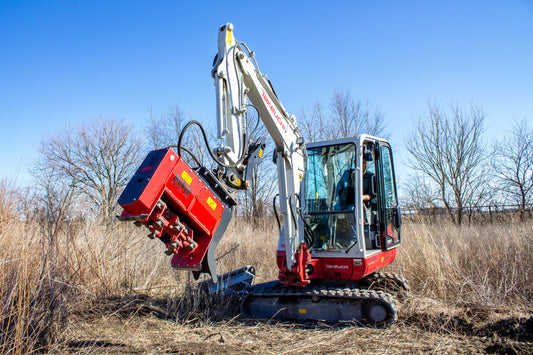
A mini excavator mulcher puts controlled, arm-mounted clearing capability on a machine that fits where full-size equipment cannot go. Fence lines through standing timber, creek banks with limited staging room, confined job site interiors, food plot borders in tight woodland pockets, and property perimeters with restricted gate access are all scenarios where compact machine operators need a mulching solution sized and weighted for their carrier.

Running an oversized mulcher head on a small excavator arm strains the coupler, reduces hydraulic efficiency, and produces inconsistent cutting results across the pass. Our mini excavator mulcher catalog covers verified options from Ferntree, Freedom Attachment, Remet, and Simatech built specifically for the hydraulic output and carrier weight ranges of compact and mini excavator classes from 1.5 tons through 12 tons.

Why Machine Weight And Hydraulic Output Drive The Selection

A mulcher for mini excavator applications is constrained by two non-negotiable variables: the carrier's operating weight class and its hydraulic flow output. An attachment that exceeds the machine's rated carrier weight creates arm load conditions the excavator was not designed to sustain.

A mulcher whose motor demands more hydraulic flow than the machine can produce will either stall under load or run the hydraulic system past its thermal threshold during extended clearing cycles, a mismatch Stucchi USA identifies as one of the fastest ways to overheat a mini excavator's hydraulic system. Both outcomes cost more in downtime and repairs than the price difference between a correctly matched unit and a mismatched one. Every product in our catalog is specified with the carrier weight range and hydraulic flow requirements verified by the manufacturer.

The Role Of Mulching In Compact Excavator Operations

Mini excavators running mulchers handle vegetation management tasks that bucket-and-thumb configurations cannot handle efficiently: clearing brush from creek banks without disturbing the bank, removing standing woody material from fence lines without creating debris piles, managing overgrowth in drainage corridors, and processing timber residue on food plots. The reach of the excavator arm adds a dimension that ground-based compact mulching equipment cannot replicate, giving the operator clearance distance from the material being processed while the mulcher head works on terrain the carrier is not directly positioned on.

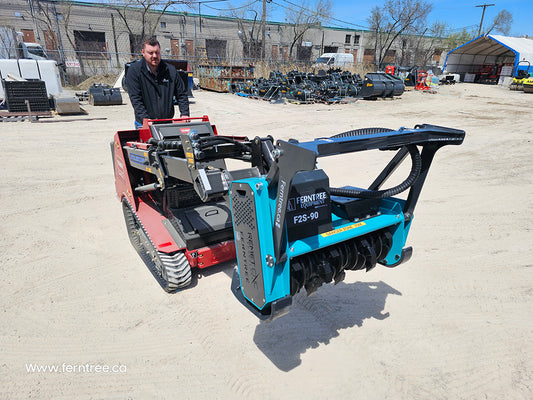
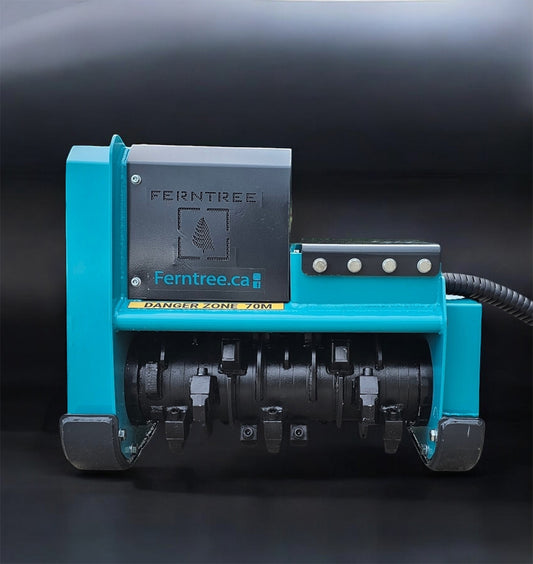
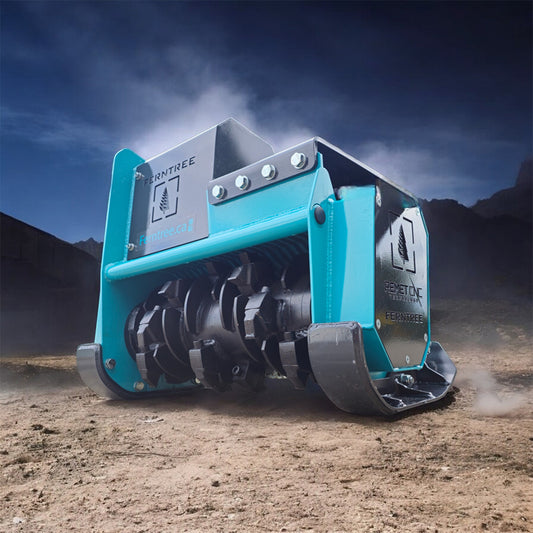
The Ferntree FF-L Series is the most versatile mini excavator forestry mulcher in our catalog for the range of machine weights it covers. Designed for carriers from 2.5 to 6 tons, the FF-L Series covers cutting widths from 22 to 30 inches with Bite Limiter technology that controls material intake at the rotor to prevent overloading on heavy brush and small-diameter timber. This technology is particularly relevant for operators running machines at the lower end of the weight range, where an unrestricted rotor pulling too much material at once creates torque spikes that exceed the hydraulic motor's rated capacity.

Bite Limiter Technology And What It Means For Compact Machine Operators

Bite Limiter technology on the Ferntree FF-L restricts the amount of material the rotor can take in per rotation. On compact machines with lower hydraulic flow, this translates into sustained cutting performance on dense material without the motor stalling or the hydraulic system overheating on extended clearing cycles.

Operators running 2.5- to 4-ton mini excavators on brush-heavy work will find the Bite Limiter configuration more forgiving across variable material densities than an unrestricted rotor, which requires manual feed-rate management through boom-speed control. The 22-inch cutting width suits smaller carrier machines, where a narrow attachment width maintains arm stability, while the 30-inch width suits 5- to 6-ton carriers, where wider passes reduce total clearing time on larger plots.

Fixed Tool Rotor Configuration For Heavier Material

The FF-L Series runs a fixed tool rotor rather than a flail rotor, meaning cutting tools maintain a fixed position relative to the rotor body rather than swinging freely. Fixed tool rotors generate higher cutting force per tooth contact on woody material, making them suited to operators clearing established brush lines, young timber stands, and material in the 1 to 3-inch diameter range. For operators needing the fixed-tooth advantage at a larger cutting width and on heavier carriers, the Ferntree F2-E70VM offers a 27-inch cutting width and a 12-inch maximum cutting diameter for machines from 5 to 12 tons.

Rotor type is the most consequential specification decision after machine weight matching on a mini excavator mulcher attachment. Flail, fixed tooth, and disc configurations all process material differently and suit different clearing applications. Choosing the right mulcher head for mini excavator work depends on three factors:

  • Material diameter and density: flail for light vegetation under 2 inches, fixed tooth and disc for established brush and timber up to the mulcher's rated cutting capacity
  • Hydraulic flow available from the carrier: flail rotors draw less flow than disc or fixed tooth at equivalent cutting widths
  • Finished surface requirement: disc mulchers produce finer, more uniform output; fixed tooth rotors produce coarser chips; flail produces the finest particle on light material

Our catalog covers all three rotor types so operators can specify the right configuration rather than accepting whatever a single-brand dealer has in stock.

Flail Rotors For Light Vegetation And Lower-Flow Machines

The Simatech DHL Range Mulcher covers machines from 1.5 to 5 tons, with a flail rotor configuration suited to grass, light brush, and vegetation management, where the material diameter consistently stays under 2 inches. Flail rotors generate lower hydraulic demand than fixed-tooth or disc configurations at equivalent cutting widths, making them the appropriate choice for operators whose machines produce lower hydraulic flow. The Simatech DHL suits compact mini excavator operators running light maintenance, clearing on property borders, food plot margins, and managed lawn areas where the primary task is managing growth between seasons rather than processing established woody vegetation.

Fixed Tooth And Disc Rotors For Heavier Material

The Remet F2S90 SSK 90 is a dual-platform mulcher running on both mini skid steers and mini excavators, with a fixed-tooth rotor configuration that handles brush and small-diameter timber at a production rate the flail configuration cannot match on established material. The dual-platform compatibility makes the Remet F2S90 a practical investment for operators who run both machine types across their operations, as a single attachment serves both platforms without requiring a separate adapter or coupler system.

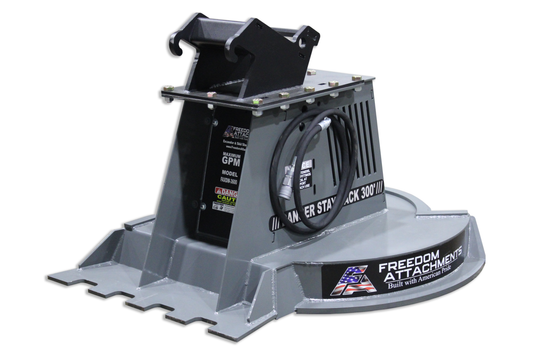
The FA FAXDM Disc Mulcher offers 28- and 36-inch cutting widths for machines rated from 1.5 to 8 tons. Disc mulchers process material through rotating disc blades rather than a drum rotor, producing a finer finished mulch particle and a cleaner surface cut on brush and woody debris at the cost of higher hydraulic demand than equivalent flail configurations.

The disc mulcher configuration on a mini excavator produces a different surface result and material output than a drum rotor unit of equivalent cutting width. Understanding the practical difference helps operators specify the right tool for the clearing outcome they need, not just the clearing task in front of them.

FA FAXDM 2800 And 3600 Disc Mulcher Performance

The FA FAXDM 2800 covers a 28-inch cutting width for 1.5 to 8-ton mini excavators. The FAXDM 3600 steps up to a 36-inch cutting width across the same machine weight range, giving operators a wider cutting path per pass without stepping outside the compatible carrier class. Disc mulcher output tends to be finer and more uniform than drum rotor output because the disc blade creates a shearing cut rather than an impact cut. For food plot preparation, the surface left after clearing is cleaner and requires less follow-up before seeding. On habitat management clearing where a natural-looking finished surface matters for wildlife use of the area, disc mulching produces a less visually uniform output that blends into the natural environment more readily than the consistent chip pattern a drum rotor generates.

Matching Disc Mulcher Hydraulic Requirements To Mini Excavator Output

Disc mulchers typically demand more hydraulic flow than flail configurations at equivalent cutting widths because the disc blades require higher rotational velocity for effective cutting force. Operators specifying the FA FAXDM models should verify their machine's hydraulic flow output matches the mulcher's requirements before purchase. On machines at the lower end of the 1.5 to 8-ton range with lower output, a flail configuration may be the more reliable choice for sustained clearing without thermal stress on the hydraulic system.

A mini excavator mulcher head delivers the strongest return on investment in applications where the compact machine's reach, positioning flexibility, and site-access advantages directly reduce clearing time compared to alternative methods. Three application categories consistently produce the highest per-hour value from a mini excavator mulching setup.

Creek Bank, Drainage, And Slope Clearing

Creek bank vegetation management requires clearing material from unstable ground that a ground-based machine cannot safely access without disturbing the bank, the same riparian zones EPA's forested buffer guidance identifies as critical for stabilizing streambanks and filtering runoff.

A mini excavator positioned on stable ground uses the arm to position the mulcher head on the slope, clearing invasive brush and encroaching woody growth without the carrier ever contacting the unstable bank surface. Drainage corridor maintenance follows the same logic: the machine stays on the road edge or ditch shoulder while the arm delivers the mulcher head into the vegetation zone. These applications suit the Ferntree FF-L Series and Simatech DHL for operators running lighter carrier machines where stability on uneven terrain is a priority.

Food Plot Border Clearing And Timber Stand Improvement

Food plot operators managing woodland borders and timber stand improvement on hunting properties find mini excavator mulching more precise than ground-based methods for clearing specific stems, maintaining defined plot edges, and removing encroaching brush without disturbing surrounding timber root zones, an approach consistent with National Wild Turkey Federation habitat guidance on managing woodland edges for wildlife.

The arm-mounted mulcher head provides stem-level targeting precision that a ground-based machine cannot match, enabling selective removal within a mixed stand. Our full range of mini excavator attachments covers additional tools for the food plot and habitat management workflow alongside a mini excavator mulcher purchase.

Property Perimeter And Right-Of-Way Maintenance

Service business operators running property maintenance contracts use mini excavator mulchers for fence-line clearing, right-of-way maintenance, and property perimeter work, where consistent clearing on a recurring schedule is the primary task. The compact machine's access advantage lets operators clear fence lines through standing timber, maintain right-of-way margins on narrow access roads, and process brush along property boundaries without mobilizing a full-size clearing crew. The Remet F2S90 SSK 90 and FA FAXDM models suit this category for operators who need mulcher configurations that hold up through repeated daily clearing cycles on contract schedules.

Selecting the right mulcher head for a mini excavator requires knowing the carrier's operating weight, hydraulic flow output, coupler type, and the primary material type the operator clears across a typical season. Getting one of those details wrong results in a mulcher that either underperforms or stresses the machine in ways that add up to repair costs. Our sourcing process addresses all four variables before an order ships.

Machine Matchmaker For Confirmed Compatibility

Our Machine Matchmaker tool lets operators enter their mini excavator make, model, and operating weight to see a filtered view of compatible mulcher options from our current inventory. This removes the manual cross-referencing process across manufacturer spec sheets and surfaces only the units verified for the machine entered. The tool covers the full mini excavator weight range, from compact 1.5-ton machines to the upper end of the mini class at 12 tons, across all brands in our catalog.

Direct Procurement And Multi-Brand Sourcing

We carry Ferntree, Freedom Attachment, Remet, and Simatech options because our job is to find the right configuration for each operator's machine and application, not to sell what one manufacturer produces.

Seven generations of procurement experience mean our direct manufacturer relationships allow us to source configurations, cutting widths, and rotor specifications not currently in our listed catalog when an operator's requirements fall outside what we have in stock. Our nationwide service network stays available after delivery to support the attachment across its full working life.